

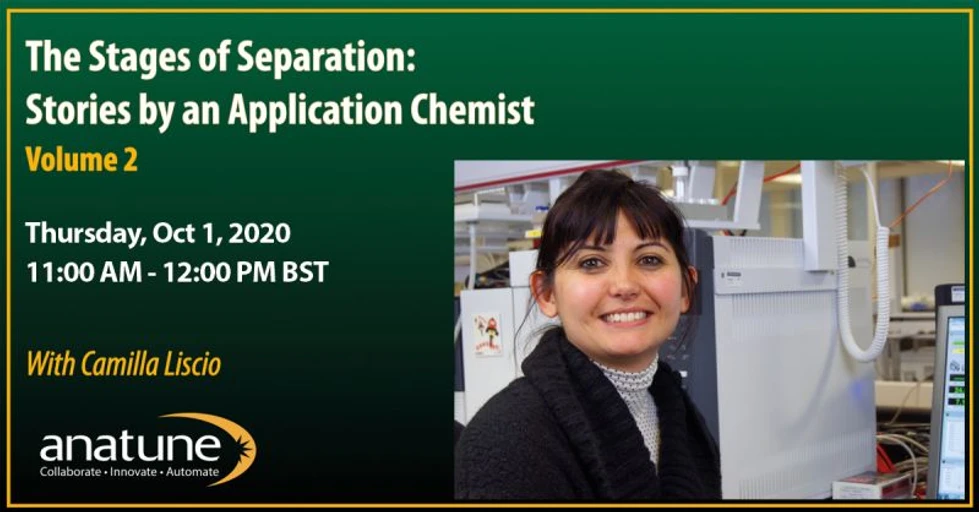
The Stages of Separation: Stories by an Application Chemist Volume 2
The shape of this talk will be in your hands with participants polling on where the talk goes. Download the PollEverywhere app (linked below) to have your say.
If you attended the first session of this, worry not. Camilla has amended her questions to omit what she has already presented.
Separation is a process allowing “the division of something into its constituents or distinct elements”. As such, it is at the core of any analytical approach. It’s only through separation that sample complexity can be unravelled and explained.
Separation has been mostly driven by hyphenated techniques, in particular chromatography and mass spectrometry.
Recently though, automated sample preparation has given access to an array of very effective and selective separation approaches (e.g. dispersive liquid liquid microextraction (DiLLME, smartSPE®) which are crucial in separating analytes from complex matrices or even classes of analytes.
On a different angle, post-acquisition data processing in combination with chemometrics is a less orthodox but just as effective approach to separate analyte information from background noise.
There are so many separation capabilities that deserve a mention.
Which ones we discuss will be up to you.
Presenter: Camilla Liscio
Camilla is one Anatune’s most experienced and effective method developers. Her background in metrology – the science of measurement and statistics – give her a deep understanding of the mathematics underpinning all of analytical science.
This, coupled with her years solving complex analytical problems for LGC and Anatune puts her on extremely strong foundations for method development.
If you aspire to become a rising star in your organisation or know anyone earmarked for great work, this is a must attend series.


