

Experimental Design for Characterizing “Smoke Taint” in Cannabis and Hemp Plant Extracts
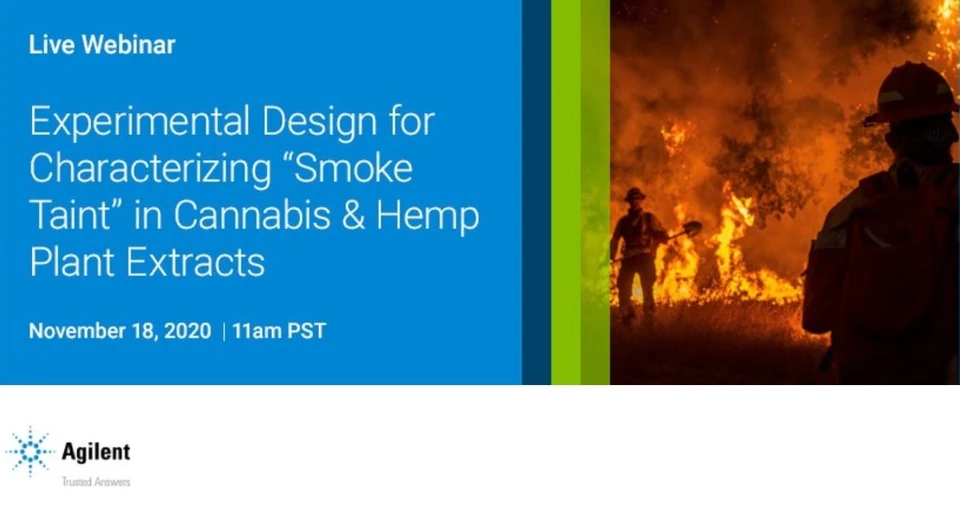
Wildfires in the western United States have significant impacts not only on the loss of life, wildlife, forests, and property but also negatively effects agricultural industries including wine, cannabis, and hemp. The heavy smoke and ash from these fires inundates hundreds if not thousands of square miles and settles on the flora, fauna, and the topsoil resulting in volatile phenols (VP) tainting agricultural products with undesirable organoleptic properties. Colloquially referred to as “smoke taint”, these chemicals render negative characteristics to plants.
Smoke taint further threatens “organic” labelling especially if a crop was exposed to smoke primarily from industrial or residential properties where more toxic chemicals are released compared to forestry fires. Another effect of the smoke and ash is to reduce exposure to sunlight impeding growth and maturation of cannabis and hemp plants.
To better characterize and understand the current and future impacts on their product, cannabis and hemp growers need a reliable analytical methodology that effectively identifies VP markers of smoke taint in their products. Early identification can facilitate mitigation processes such as exposure to high powered fans as soon as possible in the growth cycle. In this work, we demonstrate a gas phase -tandem mass spectrometry application that easily integrates into contemporary cannabis testing laboratories. Proof of principle experiments examine sample preparation techniques consistent with that performed for determinations of total cannabinoids and the analysis does not require special sample introduction technology. In this way, laboratory techniques and instrumentation will fit well into the current day-to-day cannabis and hemp laboratory workflows.
Presenter: Anthony Macherone, PhD (Senior Scientist, Agilent Technologies, Inc.)
For the past several years, Anthony has been leading a team of Agilent scientists for the development and deployment of analytical testing methodologies to assure quality and safety of cannabis products. Anthony has written extensively on cannabis testing methodologies, solving complex problems encountered when using certain analytical systems, and contributed several chapters to books on the subject. In June 2020, Anthony joined Cannabis Science and Technology®’s Editorial Advisory Board.


